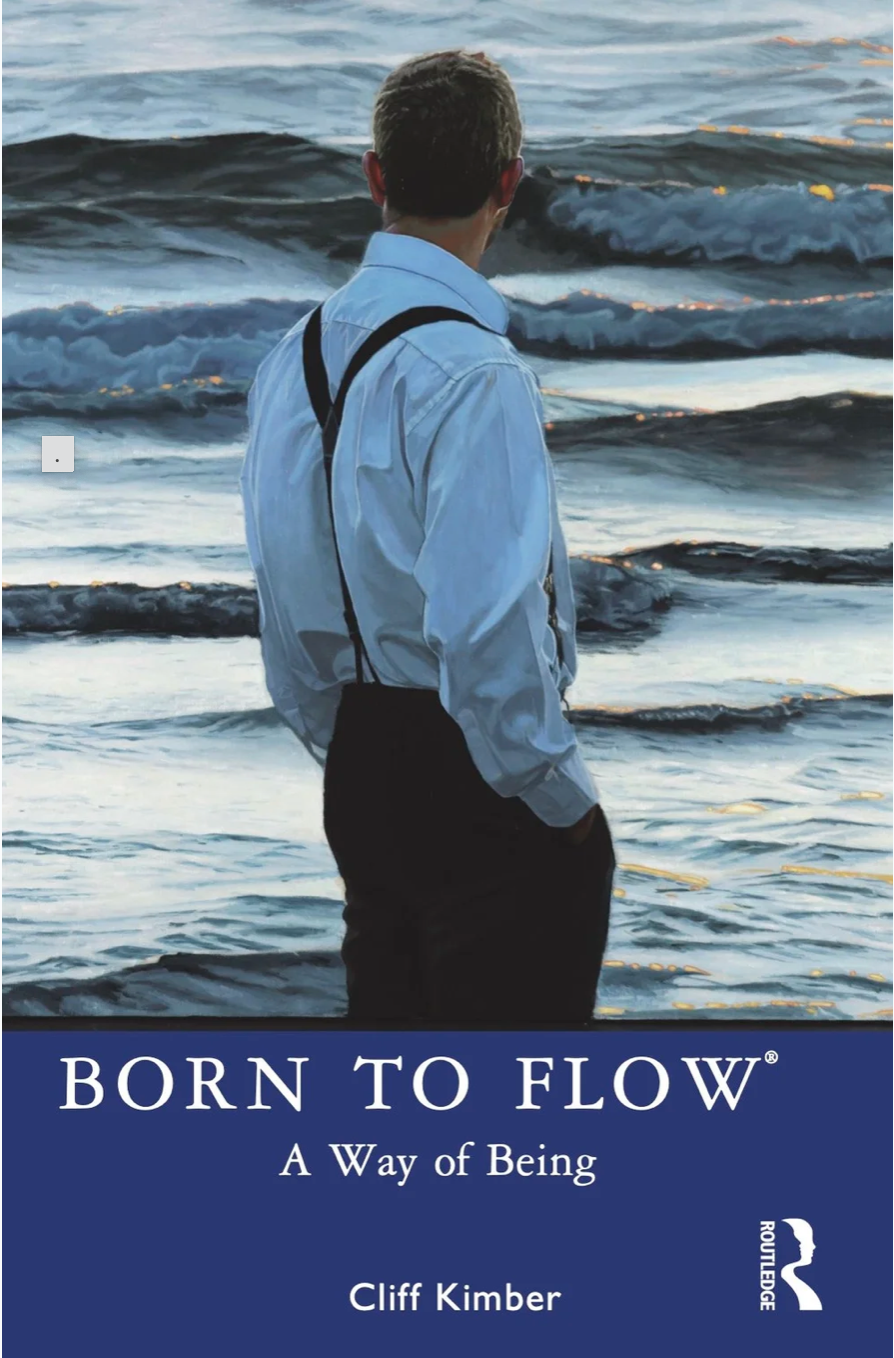
Born to Flow: A Way of Being®
What if flow is not something you achieve, but something you learn to participate in?
We tend to think of flow as a state. Something we enter when the conditions are right, when performance becomes effortless and everything seems to come together.
Born to Flow begins elsewhere. It defines flow as a complex, dynamic, psychological process.
Something we experience, participate in and continually adapt to.
Something we curate, not control.
The book explores what this might mean for how we live, work, think, create and perform.
Flow
Flow is central to Cliff's work and thinking. Born to Flow began with a simple observation: we know flow because we know friction.
Movement is never entirely free of resistance. There are interruptions, alterations, diversions and changes in the terrain through which we move. The flow changes. So do we.
The relationship is not one-way. We shape our environment and our environment shapes us. What happens next emerges through that continuing interaction. Flow, in this sense, is not a destination or a condition to be maintained.
It is something we participate in.
Curate, not control
Flow is something you curate, not control.
This is one of the central propositions of Born to Flow. To curate is to pay attention to conditions.
What are we noticing?
What are we allowing?
What are we resisting?
What is creating friction?
What might need to change?
There is no final answer to these questions. The conditions change, and our relationship with them changes.
The invitation is to participate consciously in that process.
Potential and performance
Born to Flow is concerned with performance, but it is not simply a book about performing better.
It is concerned with the relationship between potential and expression.
Potential is performance leaving the body.
What we think, create and do is how potential becomes manifest and visible in and to the world.
The question, then, is not simply how to maximise potential, It is what allows potential to find expression?
Flow and flux
The river provides one of the book's recurring metaphors because it makes visible something that is otherwise difficult to describe.
A river flows, but it does not flow through an unchanging world. Its course alters. Its banks alter. Its tributaries join it. Its waters divide. New channels emerge. The relationship between the river and the terrain is continually changing.
So it is with us.
We are not outside the flow of our lives, observing it and attempting to control it. We are part of it.
An invitation
Born to Flow is not intended to provide a final theory of flow. But it is an invitation to look again.
To notice the relationship between intention and action, movement and resistance, potential and expression.
To experiment with the conditions in which we live and work. To recognise that flow is not something that happens to us.
We participate in it. And perhaps the question is not whether we are in flow.
But how consciously we are participating in it and curating it.
The book
‘Born to Flow: A Way of Being’, draws on psychology, philosophy, creativity, coaching and lived experience.
The thinking has been influenced by Mihaly Csikszentmihalyi, Alan Watts, Bruce Lee, Rick Rubin, George Kelly and Joseph Campbell, David Bohm, and Leroy Little Bear among many, many others. It is an exploration rather than a prescription. A continuing campaign rather than a destination.
An invitation to participate consciously in flow.
Born to Flow: A way of Being®
Born to Flow: A Way of Being
Cliff Kimber
Published by Routledge in 2026.